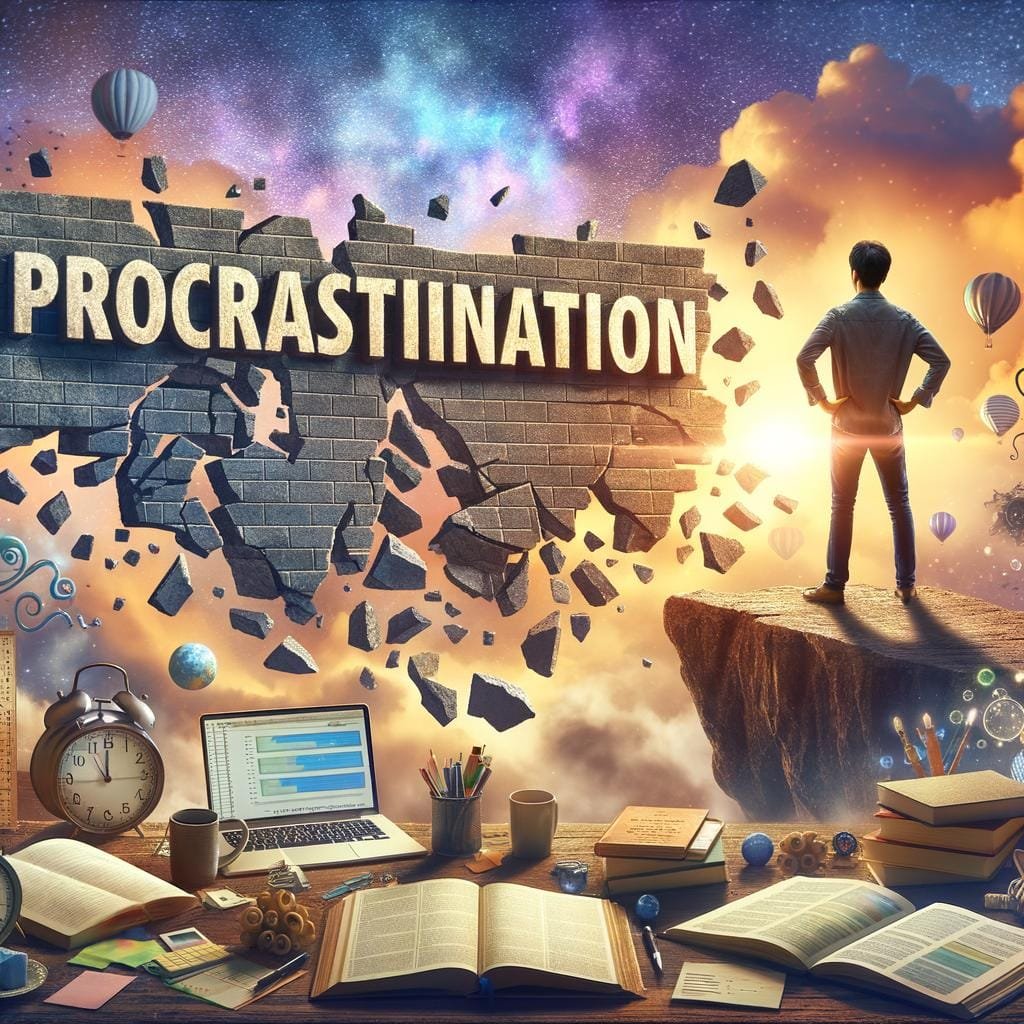
Feeling that familiar dread creep in when you know you should be tackling a task? You're not alone. The struggle to move from intention to action, often known as procrastination, is a universal human experience. In fact, research suggests up to 95% of us fall prey to it occasionally, with 20% experiencing chronic patterns. But what if Overcoming Procrastination & Boosting Daily Productivity isn't about willpower, but about understanding your brain and applying smart, actionable strategies?
This guide isn't about shaming you for putting things off. It's about empowering you with the tools and insights to rewire your habits, make progress, and feel good about what you accomplish every day.
At a Glance: Your Path to Productivity
- Procrastination isn't laziness: It's a complex psychological response, often a short-term coping mechanism for negative emotions.
- Your brain is wired for it: The battle between instant gratification (limbic system) and long-term planning (prefrontal cortex) is real.
- Small steps, big wins: Breaking tasks into tiny, manageable pieces is your superpower.
- Time is your ally: Use techniques like Timeboxing and the Two-Minute Rule to build momentum.
- Design your world: Optimize your environment to make starting easier and distractions harder.
- Be kind to yourself: Self-compassion, not self-criticism, is key to sustained progress.
- Accountability works: Leverage social commitment to stay on track.
The Elephant in the Room: What Procrastination Really Is
Let's clear the air: procrastination is not a moral failing. It's not a sign of laziness or a lack of ambition. Instead, it's a deeply ingrained behavioral pattern, a complex psychological mechanism. At its core, it's often an attempt to avoid negative emotions associated with a task — anxiety, uncertainty, boredom, or feeling overwhelmed.
Imagine a task: filing your taxes, starting a big project, making a difficult phone call. Your brain anticipates the stress, the potential for failure, or even just the sheer tedium. Rather than face these unpleasant feelings now, it seeks immediate relief, often by distracting itself with something more pleasant or less demanding. That's the instant gratification mechanism kicking in, overriding your long-term goals.
The Hidden Costs of Delay
While procrastination offers fleeting relief, its long-term impact can be significant. Chronic procrastination isn't just about missing deadlines; it chips away at your well-being:
- Increased Stress & Anxiety: Constantly putting things off leads to a vicious cycle. The stress of looming deadlines often doubles, with research showing up to a 40% increase in anxiety levels.
- Reduced Quality of Work: Rushing to finish at the last minute rarely results in your best effort. Work quality can drop by 25% or more.
- Damaged Reputation & Relationships: Missing commitments erodes trust with colleagues, clients, and loved ones.
- Health Deterioration: The chronic stress can manifest as sleep problems, poor eating habits, and overall health decline.
- Lost Opportunities: Procrastination can prevent you from pursuing new goals, learning new skills, or taking advantage of timely opportunities.
Why We Get Stuck: Understanding the Brain's Role
To truly overcome procrastination, we need to understand its roots, which lie deep within our brain's architecture and our psychological responses.
The Brain's Inner Battle
Our brains are constantly weighing immediate rewards against future benefits. This often pits two key systems against each other:
- The Limbic System (Emotional Brain): This ancient part of your brain is all about survival and immediate gratification. It seeks pleasure, avoids pain, and responds to urgency. When a task feels daunting or unpleasant, the limbic system screams, "Avoid!"
- The Prefrontal Cortex (Rational Brain): This is the newer, more evolved part responsible for planning, decision-making, and impulse control. It understands long-term goals and consequences.
The problem? The limbic system often has the loudest voice, especially when facing something difficult or uncertain.
The Temporal Discounting Effect
Our brains inherently undervalue future rewards compared to immediate ones. A distant deadline feels less urgent and less important than the immediate satisfaction of checking social media or watching a video. This "temporal discounting" makes it harder to motivate yourself for tasks with payoffs far in the future.
Emotion Regulation Failure
This is arguably the most critical insight: procrastination is often a failure of emotion regulation. It's not about being unable to manage time; it's about being unable to manage unpleasant emotions. You're not avoiding the task itself, but the negative feelings associated with it — boredom, frustration, anxiety, insecurity, or even the fear of success. Avoiding the task provides temporary emotional relief, but at a high cost.
Common Mental Traps That Trip Us Up
Beyond the neuroscience, several thought patterns keep us stuck:
- Overthinking the "Why": Getting bogged down in existential questions about why you're avoiding something, rather than just starting.
- Comparing Yourself to Others: Seeing others effortlessly achieve can paralyze you with feelings of inadequacy.
- Waiting for the "Perfect Time": There's no such thing. Waiting for inspiration or ideal conditions is a common delay tactic.
- Perfectionism: The fear of not doing something perfectly can prevent you from doing it at all.
- Overcomplication: Attaching too many nuances or creating arbitrary, unrealistic timelines for simple tasks.
- Stating Too Many Tasks: Overwhelm from an impossibly long to-do list.
Understanding these traps is the first step. The next is to build strategies to bypass them.
The Path Forward: Actionable Strategies to Conquer Procrastination
True productivity isn't about working harder; it's about working smarter and understanding your own psychology. Here are proven strategies to help you get started and stay consistent.
1. Breaking Down Tasks & Starting Small: The Momentum Hack
The biggest barrier to productivity is often simply starting. Large, complex tasks feel overwhelming. The key is to make the first step so tiny and inconsequential that your brain can't object.
- Task Breakdown (The Micro-Step Method):
- Take any daunting task and break it down into the smallest possible actions. We're talking micro-steps, each ideally taking no more than 15-45 minutes.
- Make the first step ridiculously simple. If you need to write a report, don't start with "Write report." Start with: "Open new document." "Name file 'Q3 Report Draft'." "Write one sentence headline."
- Use action verbs for each step. This makes them concrete and less ambiguous.
- Example: Instead of "Plan vacation," try: "Open browser to flight search engine." "Check one destination on one date." "Text partner for their preferred dates."
- The Two-Minute Rule:
- Rule 1: If a task takes less than two minutes, do it immediately. This could be replying to an email, washing a dish, putting something away, or scheduling an appointment. These small wins add up and clear mental clutter.
- Rule 2: For any task longer than two minutes, commit to working on it for just two minutes. This is a powerful trick. Your brain's resistance is highest at the beginning. By agreeing to just two minutes, you bypass that initial friction. Studies show this simple commitment increases the probability of continuing by 78%! Once you've started, dopamine is released, and often, you find yourself continuing much longer.
- "Trick Your Brain" by Lowering the Bar:
- Sometimes, even two minutes feels too much. In these cases, agree to do only part of a task, without the expectation of finishing.
- Example: "I'll go to the gym, but I don't have to work out. I can just walk in, sit down, and leave." Or "I'll sit at my computer with my document open for 5 minutes. I don't have to write anything." This reframes the expectation, reduces pressure, and often leads to spontaneous action.
2. Time Management & Focus: Sculpting Your Workday
Effective time management isn't about cramming more into your day, but about intentionally allocating your energy and focus.
- Timeboxing (The Focus Accelerator):
- Set a clear, fixed time limit for a specific task (e.g., 25, 45, or 90 minutes).
- During this "time box," work with absolute focus, eliminating all distractions. Use a timer.
- Crucially, stop when the timer goes off, whether the task is complete or not. This creates urgency and removes the "must finish" pressure, which can be paralyzing.
- This technique has been shown to lead to 33% faster task completion and a 55% reduction in procrastination frequency. It trains your brain to concentrate for specific periods.
- Focus on Priorities (The Essentialist Approach):
- Many tasks on your list might not be truly essential. Regularly ask yourself: "If this didn't get done, would I be fine with that? Why does it matter?"
- This brutal honesty helps you identify and eliminate non-essential tasks, freeing up mental and actual time for what truly matters.
- Focus on the few tasks that will create the most impact. What are your "needle movers"?
3. Goal Setting & Planning: Automating Your Success
It's one thing to have goals; it's another to have a plan for how you'll achieve them.
- Implementation Intentions ("If-Then" Planning):
- This powerful technique involves creating pre-decisions about specific actions in specific situations, effectively automating your behavior.
- Format: "If [situation X occurs], then I will [execute behavior Y]."
- Examples:
- "If I wake up before 7 AM, then I will immediately put on my running shoes."
- "If I finish my last meeting of the day, then I will spend 25 minutes reviewing my to-do list for tomorrow."
- "If I open social media during work hours, then I will immediately close the tab and open my work document."
- This clarity removes decision fatigue and makes actions more automatic, increasing goal achievement rates by 2-3 times.
4. Environment & Friction Management: Design Your World for Action
Your environment profoundly influences your behavior. You can design it to either encourage or discourage procrastination.
- Increase Distraction Friction: Make it harder to get distracted.
- Physical: Keep your phone in another room or drawer, turn off all non-essential notifications, use noise-canceling headphones.
- Digital: Use website blockers for social media/news sites, log out of personal email/social accounts, close all non-work tabs.
- Example: Instead of just "turning off notifications," put your phone in a locked box in a different room.
- Reduce Execution Friction: Make it easier to start your desired tasks.
- Preparation: Prepare materials the night before. Lay out your workout clothes, pack your lunch, set out your books for studying.
- Visibility: Write tomorrow's tasks tonight and place them prominently on your desk. Keep frequently used tools within arm's reach.
- Automation: Set your computer to auto-open necessary work apps when you turn it on. Place your target tasks visibly on your desktop.
- The 20-Second Rule: James Clear, author of Atomic Habits, suggests making good habits 20 seconds easier and bad habits 20 seconds harder. For example, charging your running shoes right by your bed (reducing friction) versus charging your phone outside your bedroom (increasing friction for distraction). This small difference adds up.
For more insights into creating a daily routine that supports your goals, check out Your guide to a bad daily.
5. Self-Perception & Mindset: The Power of Compassion
How you talk to yourself when you procrastinate makes a huge difference. Self-criticism is a common trap, but it's counterproductive.
- Practice Self-Compassion: Research consistently shows that self-criticism increases procrastination, while self-compassion reduces it. Treat yourself like a good friend.
- Mindfulness: Acknowledge that you're procrastinating without judgment or avoidance. Simply observe the feeling.
- Common Humanity: Remind yourself that everyone struggles with this. You're not alone or uniquely flawed.
- Self-Kindness: Instead of berating yourself, ask: "What small, kind thing can I do now to move forward?" Forgiving past failures leads to less procrastination, not more.
- Accept Imperfection: The pursuit of "perfect" is a major cause of paralysis. Understand that done is better than perfect. Pick a strategy, commit to trying it, and be flexible to adjust. The goal is progress, not flawless execution. Give yourself permission to make mistakes and learn from them.
6. Accountability & External Reinforcement: Harnessing Social Pressure
Sometimes, the best way to get things done is to involve others, leveraging the power of social commitment.
- Accountability Partner:
- Find a friend, colleague, or mentor with whom you can share your goals and weekly progress.
- Simply knowing someone is expecting an update can be a powerful motivator. People with accountability partners are 65% more likely to achieve their goals.
- Public Commitment:
- Share your goals on social media, with a team, or even with your family. This activates a sense of social responsibility and a desire to follow through.
- The mere act of stating your intention aloud can make it feel more real and binding.
- Tracking Tools:
- Use habit trackers, project management software, or even a simple spreadsheet to visualize your progress.
- Seeing a "streak" of completed tasks can be incredibly motivating, triggering your brain's desire to "not break the chain."
- External Consequences (The Ultimate Motivator):
- For truly stubborn tasks, introduce a personal consequence for missing your goal. This could be donating to a charity you dislike, doing a chore for someone else, or a self-imposed "penalty."
- To make it effective, tell someone about your consequence so they can help enforce it.
Your 7-Day Anti-Procrastination Kickstart
Ready to put these strategies into action? Here’s a plan to get you started:
- Day 1: Uncover Your Why. Identify 3 tasks you frequently procrastinate on. For each, take 5 minutes to journal why you're avoiding it. Is it fear, boredom, overwhelm, or something else?
- Day 2: Break It Down. Choose your biggest procrastinated task. Break it down into 5-10 micro-steps, each taking 15-45 minutes. Create "if-then" plans for the first 3 steps (e.g., "If I sit at my desk, then I will open the project document").
- Day 3: Optimize Your Space. Redesign your workspace. Remove obvious distractions. Prepare materials for tomorrow's most important task tonight. Apply the 20-second rule: make good behaviors easier, bad behaviors harder.
- Day 4: Master the Two-Minute Rule. Apply the Two-Minute Rule rigorously all day. If a task takes less than 2 minutes, do it now. For longer tasks, just commit to starting for 2 minutes. Watch how often you continue.
- Day 5: Timebox Your Focus. Use timeboxing (e.g., a Pomodoro Timer) for 3-4 focused 25-minute sessions. Pick one task per session, eliminate distractions, and stop when the timer rings. Take short breaks in between.
- Day 6: Build Your Support System. Find an accountability partner and share one specific goal for the coming week. Start using a simple habit tracker (even just a calendar with Xs) for one new positive habit.
- Day 7: Reflect & Reset. Take 15 minutes to reflect on the week. What worked? What didn't? Where did you feel resistant? Practice self-compassion for any slip-ups. Plan your priorities and the first few micro-steps for the week ahead.
The Journey to Action Begins Now
Overcoming procrastination isn't about eradicating it entirely; it's about reducing its grip and increasing your capacity for intentional action. It's about understanding that your brain isn't trying to sabotage you, but protect you. By applying these actionable steps, you're not just fighting a bad habit; you're rewiring your brain for easier future action, building confidence, and reclaiming your time and energy.
Remember: progress, not perfection, is the goal. Start small, observe what works for you, and make tiny, adaptive tweaks. The most important step is always the next one, no matter how small.